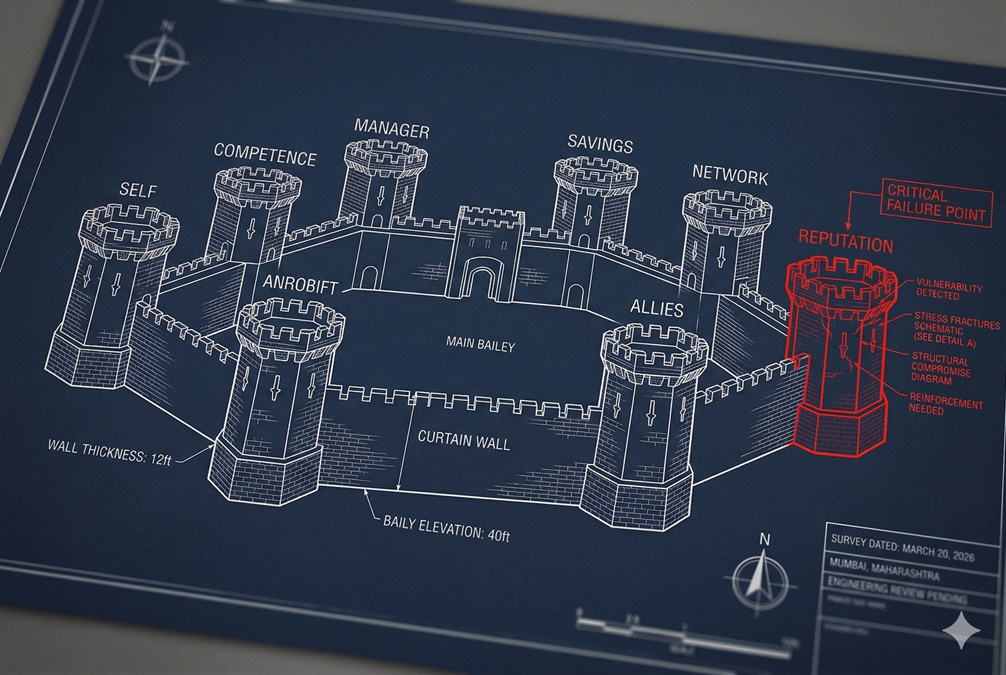
The Arthashastra’s Saptanga theory says a state requires seven elements to function: the king (leader), the minister (counsel), the territory (domain), the fortress (security), the treasury (resources), the army (capacity) and the ally (relationships). Remove any one and the state weakens. Remove two and it becomes vulnerable. Remove three and collapse is a matter of timing.
Your career is a state. The seven pillars translate with uncomfortable precision.
The king is your decision-making capacity. Not your intelligence. Your ability to act decisively when the information is incomplete. The minister is your counsel network. Not friends who agree with you. People who challenge your thinking before the market does. The territory is your domain expertise. The ground you own professionally that others cannot easily take.
The fortress is your financial security. Not wealth. Enough runway that your next career decision is made from clarity rather than desperation. The treasury is your career capital. Skills, credentials and proof of work that hold value across employers. The army is your capacity to execute. Not just ideas. The demonstrated ability to produce outcomes under real constraints.
The ally is your professional network. Not the number of LinkedIn connections. The number of people who would take your call on a bad day and do something about it.
Most mid-career professionals have two or three strong pillars and are dangerously exposed on the rest. The domain expert with no financial fortress takes bad jobs because the runway is too short. The well-networked professional with no treasury gets meetings but not offers because the skills don’t back the relationships. The financially secure professional with no counsel makes decisions in an echo chamber and wonders why the outcomes keep surprising them.
Chanakya’s insight was structural: you don’t assess a state by its strongest feature. You assess it by its weakest pillar. The chain breaks at the thinnest link. Career stagnation at mid-career almost always traces back to a missing pillar, not a weak version of an existing one.
In India, the fortress pillar is often the first to be compromised. EMIs, family obligations, educational loans. When the financial fortress is thin, every other pillar operates under constraint. You can’t pursue the right opportunity because the wrong one is paying the bills. Chanakya would recognise this as a governance failure: a state that neglected its fortress while building its army.
If you audited all seven pillars of your career right now, which one would score the lowest and how long has it been that way?
Seven pillars. Count yours. The weakest one is where the next career crisis will arrive from. careers.deliberx.com